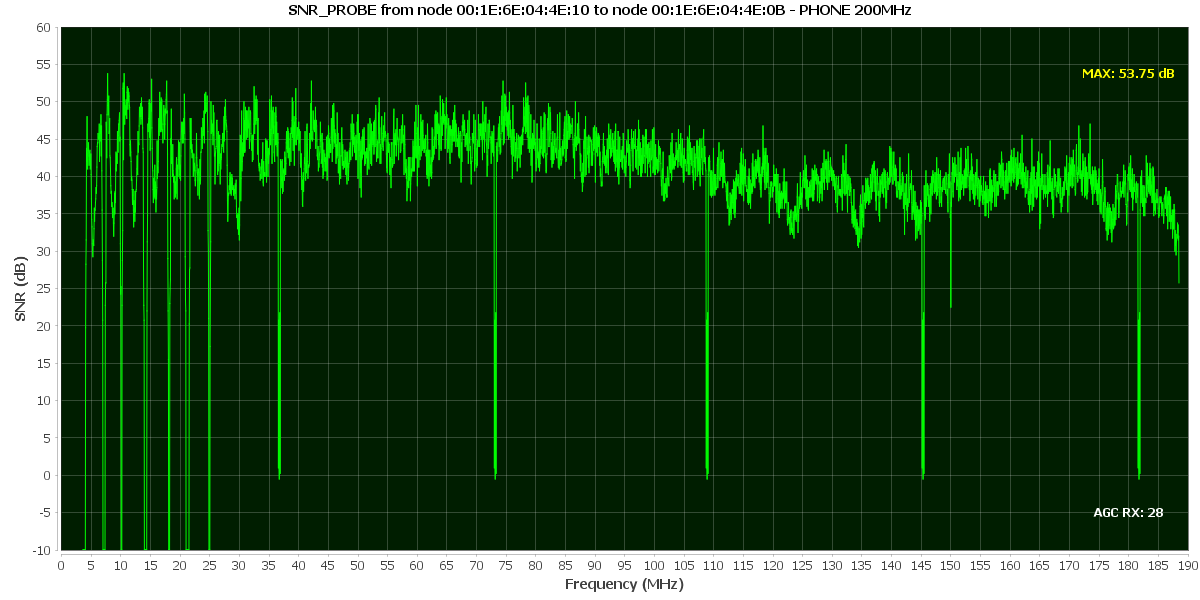
This is a fantastic result, but I am dying to know how the G.hn chipset creates the bit-loading map on a topology with that many bridge taps. In VDSL2 deployment, any unused extension socket in the house acts as an open-circuited stub, creating signal reflections that notch out specific frequencies (albeit usually killing performance).
If the author is hitting 940 Mbps on a daisy-chain, either the echo cancellation or the frequency diversity on these chips must be lightyears ahead of standard DSLAMs. Does the web interface expose the SNR-per-tone graph? I suspect you would see massive dips where the wiring splits to the other rooms, but the OFDM is just aggressively modulating around them.
A view from the the debugging tools since you asked https://thehftguy.com/wp-content/uploads/2026/01/screenshot_...
I don't think there is anything too fancy compared to a DSLAM. It's just that DSLAM are low-frequency long-range by design.
Numbers for nerds, on top of my head:
* ADSL1 is 1Mhz 8Mbps (2 kilometer)
* ADSL2 is 2Mhz 20Mbps (1 kilometer)
* VSDL1 is 15Mhz 150Mbps (less than 1 kilometer)
* Gigabit Ethernet is 100Mhz over two pairs (100 meters). It either works or it doesn't.
* The G.hn device here is up to 200 MHz. It automatically detects what can be done on the medium.
Gigabit Ethernet uses four pairs per direction. It uses the same four pairs in both directions at the same time.
When we bought our house (1950s semidetached) it needed a full electrical rewire. I’m so glad I asked the electricians to run Ethernet all over the house at the same time, including to the ceiling in some rooms for WiFi access points.
> A new house bought today could have 10 phone sockets and 0 Ethernet sockets. There is still no regulation that requires new build to get Ethernet wiring (as far as I know).
I think this is true in the sense of there's no regulation it's just up to the developer, but my house (new build, 2021) has an RJ45 patch panel downstairs with 4 ports that lead to 4 areas of the house.
This was actually a surprise to me when I got the place because when I was speaking to the sales associates they had 0 clue what I was talking about when I enquired about network cabling. If I had known they were installing it as standard I'd have asked for more ports in more rooms, but hindsight...
But yeah, there's also 4 phone sockets as well, which I don't use. This solution might be interesting to try out, but phone sockets are in the same place as where the ethernet sockets are and I've no real need to expand in those rooms right now.
When looking at new build houses a year or two back (in the UK), I saw some stuff that made no sense to me: they installed some by default, but ran it to only the lounge and bedroom 1, the house also had a dedicated study (labelled as such by them) which did not have an ethernet run to it, and they refused to let you option in any more, very weird.
[delayed]
> Basically, you need to follow the tracking regularly until the package is tagged as lost or failed delivery, which is the cue to pay import fees.
> It’s the normal procedure to buy things from Europe since Brexit 2020. It’s actually quite shocking that Royal Mail still hasn’t updated their tracking system to be able to give a status “waiting on import fees to be paid online”. They had 6 years!
Wow.
Another Brexit bonus
It’s no coincidence those that championed Brexit are those that wanted a weaker Europe and weaker U.K.
That’s why the majority of tax payers were against it, the majority of educated people voted against it, the majority of working people voted against it, the majority of people alive today who voted voted against it
Yet we still got it.
It's never to late to rejoin, we've all learned a lot about foreign propaganda in the last decade.
Someone at Davos commented "It took you 7 years to negotiate your way out, it will take you 7 years to regret and then 7 years to negotiate back in".
All while losing all goodies and setting the economy back a decade.
But the remaining wealth of the country has successfully been extracted in the form of overpriced and not-fit-for-purpose utilities, transport companies, taxes, and so on and given to corporate interests. From their perspective it's a resounding success.
We need a whole generation to die off before that becomes likely.
In the mean time we should move closer when the opportunity rises.
The apartment block I live in in Ireland has converted phone sockets into Ethernet using similar converters, except (a) it was in 2004, so 10Mbit base, (b) they ordered whole socket replacements, eliminating the need for separate box outside the walls, (c) the goal was to buy 1 business high speed line, and split it across all apartments, which became obsolete when ADSL, DOCSIS, and later FTTH became affordable options.
I heard the state of the wiring also wasn't great, sometimes apartments had twisted pair wires, while some straight wires, some only have 2 or 3 out of 4 wires connected, etc.
Good to know this technology still exists.
This wouldn't be legal in my country unless all the apartments had one owner, because the telcos have a monopoly on communications.
The law says one person can't stretch a cable over to his neighbour, because they would need a licence for that (although if you did do that, who would know?).
My parents shared coaxiale television for years with the neighbors. Technically illegal but there is no way to know with analogue television.
I think our phone lines must work differently, the entire infrastructure is owned by one company (BT) who must lease it to other companies. So they can do things like this, as everyone needs a router at the end to access it and that's how they charge per customer.
There is a separate cable network, again one operator (Virgin), who don't lease it out.
I've been using this for a couple of years in my home now, with the same German Gigacopper devices. It's rock solid, very much unlike my attempts at power-line ethernet in the past. I used ethernet over coax in my last house too, which was also great.
I think many (most?) UK houses could get gigabit ethernet to at least some rooms without any new wiring. It's strange that the devices for doing it reliably are hard to get, but powerline ethernet modems are sold everywhere despite barely working in most houses.
My experience with powerline is they can work well for low activity, but they all overheat if you actually use them continuously, and the advertised speeds are extremely misleading as they are before error correction (which is very significant) and for the whole network.
My guess is that the nature of them being in a power plug means that they struggle to isolate things from the mains for safety in a way that doesn't also make them hotboxes.
You are a god send! I have the same issue. My house (2013!!!) is fully phone wired but has zero Ethernet. I have 3 floors which each running on a different phase (the electrician wired it like that). I have a power line adapter in my fuse box to connect directly to the three phases. But I can’t stream content or large files. Even worse the power line adapters bring noise into my power sockets. A guitar amp gets ground crackling etc. will look into this solution!
I wish I knew about this when I lived in a house without Ethernet sockets! I needed it in the attic for my PC and servers and all I had were slow, unreliable TP-Link Powerline adapters. My first speed test gave me 37.1Kbps (after painfully loading Cloudflare's test page). On a really good day I could get 3MBps. I'd get disconnected multiple times a day and I had to try all sorts of methods to get the adapter to connect again. I had to write a program in the end to tell me if I didn't have internet because the Powerline broke or my DNS server broke (normally it's always DNS but turns out it wasn't) :D
I had a phone socket in that room and I had already discussed the possibility of converting it into an Ethernet socket but decided it's not worth it because everything ended up in a cupboard far away from my router. These adapters would have solved the problem nicely!
By the way, I have more fun stories. The cabling in my current house (which has Ethernet sockets) is still miserable. I spent a year working with my PC over USB tethering to my phone until I finally called an electrician to find which of the 11 dangling cables in the cupboard went to my office...
One day some wires in there were slightly moved and the internet got disconnected because they were badly crimped. Nothing was working so in the end I got an RJ45 connector and managed to get the wires in there.
> One peculiar thing from the UK: Internet providers don’t truly offer gigabit internet. They have a range of deals like 30 Mbps – 75 Mbps – 150 Mbps – 300 Mbps – 500 Mbps – 900 Mbps, each one costing a few more pounds per month than the last. This makes the UK simultaneously one of the cheapest and one of the most expensive countries to get Internet.
Andrews and Arnold[0] offer gigabit, but I'm not surprised the author hasn't heard of them; they never advertise.
This is due to advertising standards. They are required to advertise "average speed", although how this is actually calculated is nebulous.
A&A not advertising can just say what the link speeds actually are on the product pages.
Other ISP's could do this too, but it would cause confusion having one figure on the advert and one figure on the product pages, and they might get in trouble if they link to the product pages in the adverts.
I had a similar issue but instead I opted to replace all the wiring with CAT5E. I used the old phone wiring as a pull-wire to get the CAT5E through the walls very, very slowly. CAT5E was used as I needed all the flexibility I could get and 1Gbit was enough at the time.
The RJ11 panels on the wall were replaced with RJ45, crimped everything. Took a full day of carefully pulling wires but in the end I got gigabit all over the home.
The next owner will probably call me an idiot for using CAT5E in 2019.
You're the reason why the author's assertion that there is a huge untapped market for this in the UK is probably wrong; most of the people technical enough to set this up are also going to be technical enough to pull new cables.
There might be some market for a simple point-to-point device sold by the likes of Argos, zero config and including all the right cables already, aimed at people who can't or won't upgrade their cabling but want to enable their kid to play Fortnite.
But... there is no clear patent protection available, so as soon as someone successfully creates and markets that device, the Tiktok Shop clones will appear.
Pulling cables through walls is really easy for some construction styles and really difficult for others.
Can involve taking up floorboards and drilling horizontally through beams, plumber style. Or cutting slots in masonry with angle grinders. Sometimes there are existing wires you can tie to and pull through, sometimes the existing wires were stapled to the walls.
On the bright side everything about the ethernet wires and connections is trivial. Like demo to a friend in 20 minutes and let them walk off with the toolbox and they'll be fine wiring their house, if the construction style is amenable.
The twisted pair (should be two but one pair is broken...) installed in the 60s in my home are so stuck you will never, ever, get those out without ripping the wall apart. Originally the coaxials should have gone through the same pipes, as there should be enough space, but there is so much gunk in there it was impossible and they layed out a new tube though the floors and ceilings in the corner. For fun and because institutional knowledge is for suckers, they tried the same with fiber and simply gave up so now we are in limbo because computer says we have fiber but we don't.
Agreed. I tugged on each phone wire a to see if they were free. And I got lucky on all of them.
One of the problems I had was a kinked conduit where concrete was poured on top, or at least that is what I assumed. Was a bit difficult to get the “knot” (where the phone wire was connected to the CAT5E) through that spot.
> most of the people technical enough to set this up are also going to be technical enough to pull new cables.
It's really not that simple when you realize that the average UK flat has 3+ sockets and the average house has 5+ sockets (speaking from my own experience). Some daisy chained and some direct.
Besides, a lot of people are renting and cannot touch their wire.
> a lot of people are renting and cannot touch their wire.
Nobody's going to complain about a backwards-compatible upgrade (you can put phone sockets back when you leave - nobody has to know there's cat 5/6 behind it).
One of the big problems with pulling cable in the UK is the abundance of solid internal walls. Running cabling in my house involves lifting floorboards or drilling through multiple 2ft thick stone walls. It’s worth doing while you’re there but so destructive if you’re not
I am curious if you have some tricks for attaching pull-wire and CAT cable. Also, did you use any lubricant for the CAT?
I tried the same approach to replace COAX cable with CAT but the tie just broke off like 10cm before the socket exit [1], and CAT is stuck there now.
Relatively successful was slotting the cat5 jacket, cutting off two or three of the pairs, twisting/tying the remaining pair to the old wire, then sliding the jacket back over the join before wrapping in a conservative amount of electrical tape. You want the join to be similar width to the cable and preferably flexible.
I have a suspicion that pulling fishing line first is the right play if you can manage to connect it to the old wire. Flexible, very high tensile strength, small.
In addition, in one room I ran two CAT5E cables as there was conduit along the entire way. So I took a CAT5E cable double the length of the conduit, stripped the outer sheath in the middle, folded the cable to get a loop and then attached the phone cable to that using the individual inner wires. Plus tape.
I've noticed this company also has coax modems. I wonder if they will work better than MOCA adapters. I've tried MOCA at my house and the quality of the signal is not good, connection keeps dropping every 10-15 minutes for no apparent reason...
I mean on fairly short runs you can run Ethernet over water pipes if you want to. I'd try the cable on its own first without any fancy chipsets.
I've been surprisingly successful with that in the past.
I have been using the exact same G4201TM devices at home for approaching five years now to do much the same: reuse some unused telephone wiring for a meaningful purpose. They are rock solid and have needed exactly zero attention since being installed.
Lots of sympathy with this plight. Great to hear that someone has done the needful and rendered MoCA style modems over pairs of copper. I'm probably a customer for that.
I'm currently running MoCA over spliced coax as part of the local connection and not amused by the 5ms latency on it. Also running 100mbit over cat3 I found in a wall which does work, but cat3 in another wall can't hold 10mbit. That link actually can hold 70mbit of vdsl but after a nearby lightning strike slagged various hardware I've moved the vdsl modem back to the BT wires entry point and run the output through some fibre.
And there's a wifi bridge between two other points. And some ethernet running outside the building. Previously also ethernet-over-mains that I might bring back now that I've learned what spanning tree protocols are so the periodic reboots they inexplicably require can be tolerated transparently.
Also the connection to the internet itself is crap so bonding vdsl, starlink and 5g through the openmptcprouter project. Just lots of redundancy and self healing hacks all over the place to give an observably solid connection.
Which is a rambling way to say that if you're in Britain and your network connection brings you sorrow, it can be forced to be acceptable with application of more time and money than other countries require.
> the periodic reboots they inexplicably require
I've had powerline adapters with uptimes measured in years (basically in between power cuts). I think yours might be defective. They absolutely do not require reboots.
I connected self powered crank telephones to my home phone wiring for use as intercoms. Crank one and the others ring. Pick up to engage the battery powered talk circuit and you're chatting with Mabel like it's 1915. I did replace the old dry cell batteries with lithium camera cells so I don't need to think about them for a decade.
> It’s not uncommon to have a one bed flat with 2 phone sockets in the living room and 2 phone sockets in the bedroom and a master socket in the technical room. It’s ridiculous.
This sounds a bit farfetched to me. I'm 40+ and lived in the UK all my life. Growing up we only had 1 phone socket in the house for the first few years until my dad got an extension put in upstairs. I've lived in multiple cities since then and no flat or house I've lived in has had more than 1 phone socket including the house I eventually bought and live in now (which is not small by most UK standards).
I’ve lived in two apartments with the setup OP described, and they were both built 2003-2006. But I’ve not had it anywhere else, so it does seem constrained to a specific window of apartment developments
Interesting. Every place I've lived in has been older than that so that makes sense.
Wait, but you get 63MB/s down from steam?
My internet is pretty good, I can easily saturate my (rather dated) WiFi at about 30MB/s. But Steam downloads are extremely slow for me (can't remember the numbers but much less).
I always assumed Valve themselves were just stingy with bandwidth. Something else funny going on?
It might have detected the wrong country/city for you. Check Settings -> Downloads -> Region
Otherwise it's just your WiFi being patchy. I think Steam is doing "friendly" bulk download, it slows down before the connection is saturated, to avoid disconnecting your wife/mum/siblings watching Youtube or on a videoconference.
Peering between your ISP and Valve is likely saturated.
Considering Valve has an incentive to make downloads fast (= more revenue), it's likely your ISP is being stingy in this case.
And ISPs in most of the western world have no incentives to fix it, instead trying to scam Valve and others to get paid twice.
The business model of consumer ISPs is "take the money and don't deliver" so this tracks.
> Wait, but you get 63MB/s down from steam?
I usually (but not always) saturate my downlink with Steam downloads... even back when I was a Comcast customer and paying for ~180MB/s (~1500mbit/s) asymmetric service.
I believe that I have noticed that smaller games (~a few hundred MB or maybe a GB or two) will download quite a bit slower than large games, but I'm not very confident in that observation.
I've been eying the phone sockets too wondering what I can do with them. Think i'll end up running fiber though because internet is 1.6 so gigabit would be a bottleneck.
As a side note - it's quite difficult to find white fiber cables. They're all bright colour so that nobody cuts them accidentally but I don't want a pink line running along the walls haha
Here: https://www.amazon.co.uk/Elfcam®-Fibre-Optic-Multimode-Duple...
It is flat and thin enough you can stick it on top of skirting boards/etc with tiny dabs of hot glue.
A lot of British houses have coaxial cable TV in all bedrooms.
Ignoring the horrible taste of our forebears that were putting TVs where they don't belong, that does enable carrying gigabit ethernet using MoCA technology.
It sounds like his phone lines were already cat5, which is not surprisingly capable of 1Gbps.
However, I wonder why it seems G.hn is only available in the form of adapters, and not as e.g. a PCIe NIC.
Then they would need to deal with drivers.
Yeah the era of non-Ethernet/Wi-Fi NICs died off decades ago with the last ADSL cards. Nowadays I'm not sure if OSes even support creating drivers for anything non-Ethernet (especially where to provide the config UI for your non-standard protocol).
What I've seen done recently to work around this is to combine your custom chip with a standard Ethernet NIC on the same board. The computer just sees an (off-the-shelf) NIC that's always connected, and all configuration happens via IP by browsing to a specific private IP (this kinda insists on NAT though).
This seems like a lot of effort and expense to avoid either figuring out the current ethernet cable layout, or pulling new cable. It's not that hard.
And here I am struggling to get gigabit Ethernet over brand new cat6 cabling with devices bought in 2025…
I have an 8-wire phone line (twisted pair) between floors. I connected it with an RJ45 socket and it connects at Gigabit speed.
If you only have four wires available, it will usually still work at 100 MBit.
>>Phones are wireless, which is too slow to test anything.
As a random aside - I've been surprised by this recently. I got a new shiny Wifi 7 router(TPlink BE550) and my Samsung S24 Ultra can sustain 2.2Gbps over wifi, both to and from the router. At this point I'm not sure if that is the actual limit or if it's limited by the 2.5GbE port on the router since that had my NAS connected to it and I was testing transfer to and from it. And it wasn't like an inch from the router either - it did it while in my hand, on the other side of the room with me sitting on our sofa.
When it comes to wireless, top speeds are misleading and the wrong way to look at it.
You can have the shittiest link possible with lots of dropouts and still get a decent speed test result because in between the dropouts you get max speed and TCP/etc is designed exactly to smooth over such packet loss, and browser-based tests aren't able to get low-level UDP access to defuse that.
Yet such a connection will be unusable for anything real-time, think gaming or videoconferencing. That's why so many people's connection still stutters on Zoom/etc calls - the "good" connection and super fancy router their ISP sold them isn't actually that good despite speed test results being satisfactory.
Honestly, most UK houses start out with a single ISP-provided wifi router, situated somewhere close to where the data cable enters the building.
For a lot of homes, that's enough to provide good-enough internet throughout the building.
The issues arise when you've got a larger building, thick walls, lots of things competing for the same frequency band, a less great router, or you need the very lowest latency.
> For a lot of homes, that's enough to provide good-enough internet throughout the building.
It often isn't - it's just magic like TCP/etc that is doing its job and making it feel that way for bulk non-interactive transfers. But get those people on a Zoom call or anything real-time and it'll be painful (double pain if they've subsequently got terrible bluetooth headsets and/or accidentally use their laptop's internal mic).
Doesn't help stupid ISPs split their 2.4GHz and 5GHz bands on separate SSIDs so now devices can't switch automatically and you've either got people constantly hogging the 2.4 band or barely trying to hang onto the 5GHz one in conditions where falling back to 2.4 would be appropriate.
Wild to me that this developer has no access to a device with gigabit ethernet.
Time really does fly.
The way I read it, they probably have Ethernet on their gaming desktop PC, just not on a second device to run a local speed test.
He claims:
> One peculiar thing from the UK: Internet providers don’t truly offer gigabit internet.
Which might well be true where he is (ie he's limited to the equivalent of shared HFC or xDSL), but certainly isn't true everywhere.
I've had gigabit fibre (full duplex) in London since 2016, and the building had it before I arrived. It also has incredibly low latency to the major data centres of London, and not a lot more to most of western Europe.
Symnetric gigabit connections can be hard to come by in London.
If you're served by a niche fibre provider (e.g. Hyperoptic, Community Fibre) then you're golden.
There's Virgin (think Comcast) with paltry upload speeds due to the cable tech. Understandable though not ideal.
Then there's the OpenReach full fibre network with paltry upload speeds due to... ??? there appears to no good reason, other than not wanting to cannibalise their leased line business. Does anyone actually know why they don't offer a symmetric product like the niche fibre ISPs?
Full quote. The problem is the price.
> One peculiar thing from the UK: Internet providers don’t truly offer gigabit internet. They have a range of deals like 30 Mbps – 75 Mbps – 150 Mbps – 300 Mbps – 500 Mbps – 900 Mbps, each one costing a few more pounds per month than the last.
Gigabit is so much more expensive (obviously it's gone down a lot). In London 2016, I had ADSL broadband at 16 Mbps for £12/month. That building didn't have fiber at the time. When fiber finally happened... it started as 30 Mbps fiber for so much more money.
I have 150Mb/s FTTP for £37/month - upgrading to gigabit would be £75/month, for example!
It's possibly because of a ruling from the Advertising Standards Authority back in the ADSL days: https://www.asa.org.uk/resource/broadband-speed-claims-guida...
Fibre rollout in London was (is?) really, really patchy. If your building had it you were lucky. If you hadn't had it already you may well have found it impossible to get at retail.
My current apartment also had a bunch of phone sockets spread around... In a couple of hours, I've removed the existing wires and passed Ethernet wires. Quick, easy, ubiquitous and cheap.
Ok, the writer could be renting a house and not wanting to do that. But sincerely, in Portugal, the landlords couldn't care less. Maybe in the UK, they really, really love their phone sockets and don't want to replace them, don't know.
UK landlords also don't tend to invest anything in their properties.
But in the UK case, that means the old phone cables are stapled to the skirting boards and painted over with gloss paint, and the sockets were wallpapered around in the 1990s. Pull the old cables and sockets off, the paint chips off and you've got holes square holes left in the wallpaper.
And although UK landlords don't give a shit about upkeep that costs them money, they rarely miss a chance to deduct money from the deposit.
> A new house bought today could have 10 phone sockets and 0 Ethernet sockets.
That's nonsense. Not in a new house. Maybe one from 20 years ago.
Anyway nice find. It's always annoying when there's a product that you know should exist but simply doesn't.
I'm currently trying to find a reasonably priced Bluetooth Auracast receiver so I can play audio to multiple rooms from my phone (no way am I investing in Sonos after all their bullshit).
There should be loads of these but the only ones I can find seem to be battery powered wearable devices aimed at tour groups, or hundreds of pounds.
The 10 phone sockets are pretty unlikely, true, but 0 Ethernet? Probably more common than not. If anything, modern builds are doing less ethernet than ever because they assume everyone is just using WiFi.
Why would they have ethernet sockets? Only one of the four computers I own has one, and I've never used it. I don't think this is unusual.