Putting on my user hat...
"OK. Signal has forward secrecy. So messages are gone after I receive them. Great!"
Oh, you didn't turn on disappearing messages? Oh, right, then forensic tools like Cellebrite can get them. You have to turn on disappearing messages. The default is off.
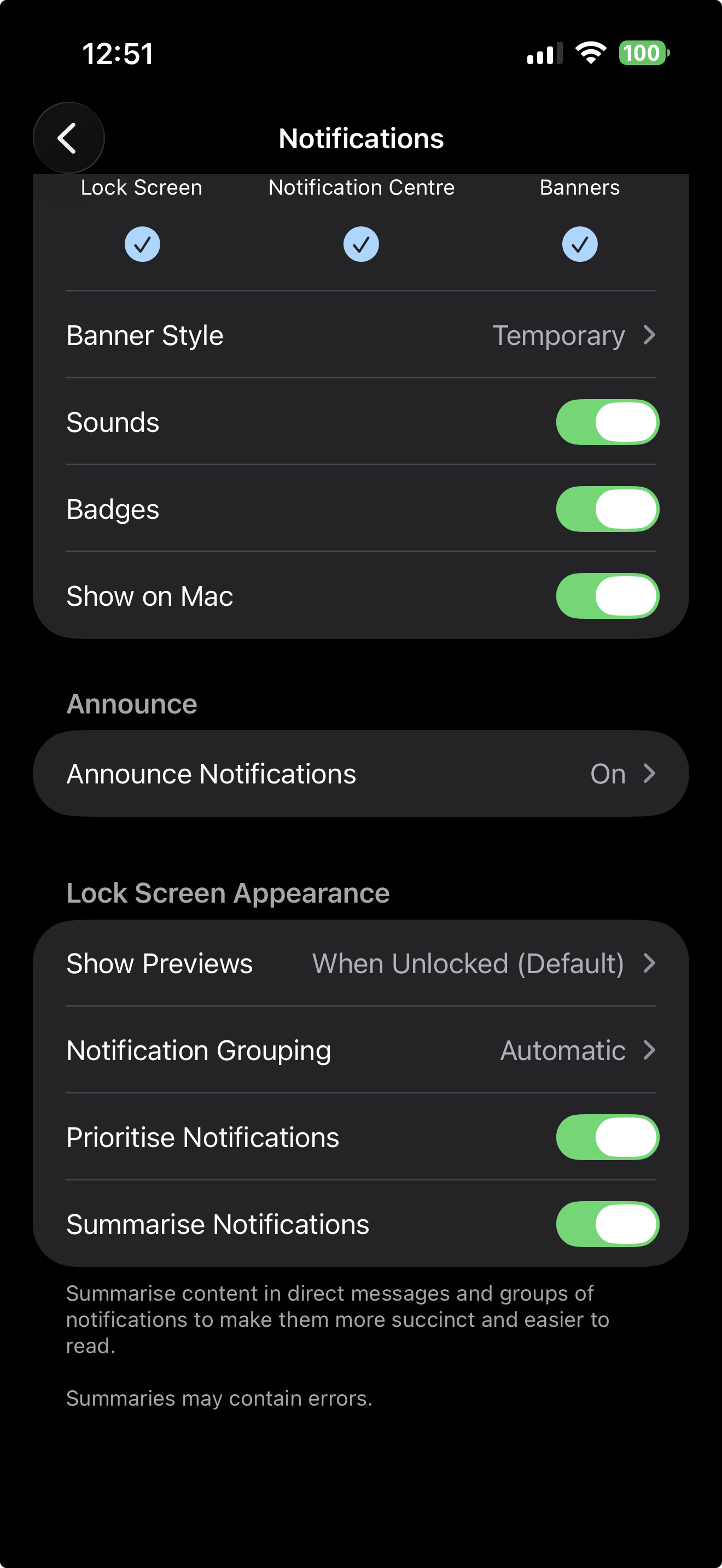
Oh, you did turn on disappearing messages? We send the messages in notifications. So the OS can keep them. Turns out Apple was doing that. There is an option you can turn on to prevent that. It is off by default.
"I'll just delete the entire app!" No, sorry, the OS still has your messages...
At what point does the usability get so bad that we can blame the messaging system?
This same app had a usability issue that turned into a security issue just last year:
End to End Encrypted Messaging in the News: An Editorial Usability Case Study (my article)
I think one of the main issues is that end-to-end message encryption is a sham as long as backups are not encrypted. I could have good device security, but if the person I'm talking to does not use ADP, iMessage and WhatsApp messages get backed up with only at-rest encryption (I think Signal opts out of standard iOS backups) and possibly the same for backups of the iPhone notification database (which the article suggests as a possibility).
Similarly on Android, WhatsApp suggests unencrypted backups to Google Drive by default.
Putting on my tinfoil hat, I am pretty sure that Google/Apple/Meta have some deal (successor to PRISM) where end-to-end encrypted messaging is tolerated as long as they have defaults that make it possible to access chats anyway. Apple not enabling ADP by default and WhatsApp doing Google Drive backups that are not end-to-end encrypted is the implementation. Since most people just use the defaults, it undermines security of people who care.
It's a 'win-win', the tech companies can wash their hands in innocence, the agencies get access to data, and phone users believe that they are chatting in a secure/private manner.
People keep pushing signal because it is supposedly secure. But it runs on platforms that are so complex with so much eco system garbage that there is no way know even within a low percentage of confidence if you've done everything required to ensure you are communicating just with the person you think you are. There could be listeners at just about every layer and that is still without looking at the meta-data angle which is just as important (who communicated with who and when, and possibly from where).
The median user isn't going to change default settings, so your app is as secure as whatever the default it.
We send the messages in notifications. So the OS can keep them. Turns out Apple was doing that. There is an option you can turn on to prevent that. It is off by default.
At least on my iPhone the default is to preview messages only when unlocked [0]. This user went out of their way to show previews in a locked state which meant it was vulnerable by digital acquisition without unlock code.
> Oh, you did turn on disappearing messages? We send the messages in notifications. So the OS can keep them.
Worse than that, they did not take advantage of the ability to send that message data as an encrypted payload inside the notification.
https://blog.davidlibeau.fr/push-notifications-are-a-privacy...
Either do not include sensitive user data inside a notification by default, or encrypt that data before you send it to the notification server.
Use SimpleX if you really want a secure messenger. Endorsed by Whonix, which in endorsed by Snowden.
If the encryption security isn’t a freaking pain in every ass in the Tri county area, it’s not secure.
That’s been my go-to and I’ve yet to see it not work.
0) send a public key. 1) encrypt the file with your private key 2) send file.
WTF. This is super simple stuff.
Settings > Notifications > Notification Content > Show: "Name Only" or "No Name or Content"
I've had this enabled to prevent sensitive messages from appearing in full whilst showing someone something on my phone, but I guess this is an added benefit as well.
Just to clarify, this is within the Signal app settings—not the OS (iOS or Android) system settings.
Critical distinction, as merely changing OS notification settings will simply prevent notification content from being displayed on-screen.
Fwiw, in my Signal app on Android this setting is in
Settings > Notifications > Messages > Show
I allway say it: it is the defaults, stupid (paraphrasign).
The Defaults have to be the most sensitive ones.
If you are a supposed super secure app, this should be the default.
Disable Apple Intelligence summaries for sensitive app notifications too.
I guess enabling Lockdown mode might avoid this particular issue too, together with a bunch of other stuff?
This seems to be the default for me, at least on Android.
WhatsApp supports this too.
Settings > Notifications > Show preview
Originally enabled it just to avoid awkward moments
First, a critical setting for Signal users:
"Signal’s settings include an option that prevents the actual message content from being previewed in notifications. However, it appears the defendant did not have that setting enabled, which, in turn, seemingly allowed the system to store the content in the database."
Second, how can I see this notification history?
Not sure if it's exactly the same, but I had to add a When notification arrives with <message>, do <action> event trigger in my Crank macOS app (https://lowtechguys.com/crank) so I can show you how to do it on macOS:
      HOURS=6
      EPOCH_DIFF=978307200
      SINCE=$(echo "$(date +%s) - $EPOCH_DIFF - $HOURS * 3600" | bc)

      sqlite3 ~/Library/Group\ Containers/group.com.apple.usernoted/db2/db \
        "SELECT r.delivered_date, COALESCE(a.identifier, 'unknown'), hex(r.data)
        FROM record r
        LEFT JOIN app a ON r.app_id = a.app_id
        WHERE r.delivered_date > $SINCE
        ORDER BY r.delivered_date ASC;" \
      | while IFS='|' read -r cfdate bundle hexdata; do
          date -r $(echo "$cfdate + $EPOCH_DIFF" | bc | cut -d. -f1) '+%Y-%m-%d %H:%M:%S'
          echo "  app: $bundle"
          echo "$hexdata" | xxd -r -p > /tmp/notif.plist
          plutil -p /tmp/notif.plist 2>/dev/null \
            | grep -E '"(titl|title|subt|subtitle|body|message)"' \
            | sed 's/^  */  /'
          echo "---"
      done
In recent years, filesystem paths for system services have started to converge for both macOS and iOS so I'm thinking with jailbreak you could get read access to that database and get the same data out of it.
On android there are apps that let you see the history - i use NotiStar occasionally to see if i unwittingly dismissed important notifications. And i believe there are apps/settings that help you clear the history from the device.
But this is a reminder that these centralized notification infrastructure (FCM and APNs) store notification content (if the app is told to send content in it - signal with option enabled wouldn't send content) even if we clear local history these middleman still hold it
On a Pixel, I can see some history by going to
Android > Settings > Notifications > Manage > Notification History
So I wonder about this. The quote from the 404 media article [0] is:
“We learned that specifically on iPhones, if one’s settings in the Signal app allow for message notifications and previews to show up on the lock screen, [then] the iPhone will internally store those notifications/message previews in the internal memory of the device,” a supporter of the defendants who was taking notes during the trial told 404 Media
The default setting appears to be to only show notification preview when unlocked. Will that notification still be stored unencrypted in notification storage or is it in an encrypted store because it will preview after unlock?
It makes sense that any notification that previews on the lock screen would be unencrypted (including the case where it is encrypted but the encryption key is adjacently stored).
This all reads to me that this was a user induced OPSEC issue and Signal had the right defaults.
On android its quite easy. There is a page of a protocol address that has all notifications show. I used to have a shortcut to it. It has been years since I was on android.
But it was really useful each time I did not see a notification in time.
Edit: typo
You don't, at least not without forensics tools
I wonder how long does the system store those notifications
Just curious, how come at least once a month signal bugs me to turn on notifications? I said no for a reason, every single time - why does it keep asking?
Not implying anything evil but it feels a bit weird esp after this.
Signal developer here. It's just because notification reliability is always a top support complaint, and a lot of people turn off notifications and don't realize they've done so. Admittedly, once a month is likely too aggressive.
> why does it keep asking?
Why does any software keep asking you to do things you explicitly told them you don't want to do? Because it's in the software developer's best interest to get you to do them, not yours. We've gotten way past the point in software where we no longer expect the software to serve the user's interest and solve the user's problems. Now, the expectation is that the user gets nagged and coerced into serving the software's interest and solving the developers' problems.
EDIT: Looks like a developer confirmed this in a sibling comment already: It nags you because that solves their support problem.
Messaging platforms where people receive and promptly respond to messages are more successful in the long run. That's why SMS overtook email. If you own a messaging platform there isn't anything inherently nefarious about pushing people to enable notifications.
Pretty sure that's just iOS behavior + app design. If notifications are off, apps will occasionally prompt again to make sure you didn't disable them by accident or miss something
Reminds me what Whatsapp if you set up a 2FA PIN, which forces you to type it about every week to check if you forgot it. So annoying.
NSL, perhaps?
> testimony in a recent trial
Court cases are the real way to audit security.
Larping about security and complaining about companies responding to court orders only gets you so far. Its way more useful to look at what actually happens in reality.
I know it’s not germane to the Signal issue, but this caught my eye, “who previously pleaded guilty to providing material support to terrorists”.
The case comes with a long statement about the Antifa “organization”. Just your weekly reminder we are living under an Orwellian administration. https://www.justice.gov/opa/pr/antifa-cell-members-convicted...
Yes and no. Court cases certainly will disclose what capabilities various parties have come up with when it comes to security. However, there are documented cases where the government chooses to abandon prosecution for the sole purpose of preventing disclosure of some of their cyber capabilities.
True, court cases are one of the few times details actually surface
The recent Trivy / LiteLLM mess was also a security thing, and seems rather different.
The problem is that, in the current environment of dishonest and corrupt states, "what actually happens in reality" isn't the same as what happens in court because of parallel construction.
I wonder why Apple doesn't 'just' delete the notification data associated with the app from the internal database when the user deletes the app? It seems like asking for problems to just keep old notification content around forever.
It's one of those problems where as soon as someone notices, it's crazy that no one noticed. I can't imagine this not being overhauled going forward. It's just a bad way to operate and now it's news.
If it never hits flash that might work, but if it's in flash storage then the block may not be erased by the time its dumped.
I'm not sure precisely how the NAND controller responds to requests for raw data from blocks with "deleted" data. And if this would require decapping the flash.
Some flash will happily let you see the data and delay erasing it.
Generally flash is non deterministic about when blocks even those with entirely stale data are erased . It might be years before the block is reused due to wear leveling algorithms and it might retain data that entire time.
Here's hoping the controller for phones which hold sensitive data are more active
I think that's how the Android notification history works. If I uninstall an app, the entries in the history aren't shown anymore. You also have to opt in to notification history and toggling it off and back on clears the old entries. There's also a time window that it keeps entries for: https://source.android.com/docs/core/display/notification-hi...
If the "database" works like most other databases (eg. postgres or sqlite), deleting a row doesn't immediately cause the data to be wiped from disk, for performance reasons. Then as others mentioned you have filesystem/SSD logic that does something similar on top of that.
Original article: FBI Extracts Suspect’s Deleted Signal Messages Saved in iPhone Notification Database[0]
0. https://www.404media.co/fbi-extracts-suspects-deleted-signal...
That's unfortunately less informative if you aren't already one of their subscribers.
"However, it appears the defendant did not have that setting enabled, which, in turn, seemingly allowed the system to store the content in the database."
"[A]llowing the system to store the content in the database" where a third party, such as Apple or a government, can access it is the default
Only a small minority of users know about settings and how to change them. The vast majority of users do not change default settings. Apple knows this
“Only a small minority of users know about settings and how to change them. The vast majority of users do not change default settings.”
Even worse, whatever critical settings you may set as a sophisticated user will frequently be reset, or changed, or re-organized under different settings… And of course, set back to insecure defaults… With subsequent software updates.
This is a regular occurrence with Firefox and privacy settings.
Whatever the actual impetus is, we should act as if this is intentional.
If you care about security at all, you disable any previews on the lock screen. The lock screen is by definition visible to anyone without any authorization. Showing anything on it immediately destroys any secrecy. It must be obvious to anyone capable of elementary logic inference.
If you don't know how to disable it, you use your favorite search engine / LLM / knowledgeable relative to find out, and disable it.
But if you just didn't pay attention, "never thought about it", you don't care about security, and no amount of technical means would help, sorry.
Imagine a parallel universe where stories about use of personal computers were written from a different perspective. For example,
"However, it appears Apple's system uses a default setting which, in turn, seemingly allowed it to store the defandant's content in Apple's database"
instead of
"However, it appears the defendant did not have that setting enabled which, in turn, seemingly allowed the system to stoire the content in the database"
In the later version, the defendant, namely his inaction in not changing a default setting, appears solely responsible for the outcome. And the actor that placed a copy of his incoming messages in a database that the actor created is referred to as "the system", not the corporation that wrote the system and sold the computer with this system pre-instaalled
> Only a small minority of users know about settings and how to change them.
I couldn't believe this so went to look up some data on this.
Holy FUCK that is bleak. There needs to be way more computer education, not just "how2type" classes.
Was this not a known issue (in terms of trade-offs) for years? I recall discussion back in 2018 at least that made mention of this concern.
https://github.com/RealityNet/iOS-Forensics-References https://theforensicscooter.com/2021/10/03/ios-knowledgec-db-...
So this is where we find out the one end of e2e is the phone and not the app.
Semi-related, in whatsapp reading the text in the notification doesn't mark the message as read, so the OS is kinda mitm here.
Signal creates the notification, does it not? That's like claiming `echo "my_private_data" | notify-send` is insecure.
If piping encrypted content resulted in a plaintext notification then you'd have a right to be concerned.
Also discussed yesterday, in https://news.ycombinator.com/item?id=47703573
On Android, when I use WhatsApp and have notifications for groups turned off, I can still see that they arrive briefly and then get removed (the icon top left vanishes). I wonder often, if this is a way to push all group message content into an unencrypted data trace as well - for the same use case.
If the notification has the data, then yes. It's trivial to create an app that listens to notifications; Samsung even has one themselves called NotiStar that replicates the notification history feature that Android normally has.
I've never seen this happen, maybe you're seeing the "Fetching messages" notification that sometimes pops up for a second?
While it's definitely surprising that the OS caches this data after the notifications have been swiped away, I always thought that notifications are an obvious hole in the whole E2E encryption setup.
AIUI, Signal push notifications just saying a message was received. Signal then fetches the E2E encrypted message from the server and decrypts it locally. So Apple/Google cannot read the messages, nor can Signal servers.
So Signal is sending the notifications through Apple's ecosystem somehow, presumably to save battery life by not having a persistent connection to Signal's servers? That's what I think happens on Android, too. When I had Lineage years ago, I had a persistent connection to Signal as the notifications didn't come through Google. Unfortunately there was a persistent notification for the persistent connection with no way to remove it.
After these news Signal should ask the users ASAP and on new installs something like:
> Do you want the notifications to pass through Apple (no privacy, better battery) or through Signal itself (better privacy, but less battery life due to the persistent connection to Signal's servers.
It should be as part of the setup wizard, not inside the settings.
Correct me if I've misunderstood something.
In my recollection, which may be imperfect:
1. On android if Google Play isn't available (or you install the no Google apk version) it'll use a websocket for notifications. Apple doesn't allow a persistent connection except through their own notification framework.
2. In either case Signal doesn't send message contents through the notification framework (not even encrypted). Once Signal receives a notification the app wakes up and reaches out to the signal service directly for actual encrypted message.
3. Regardless when signal shows the contents of your message in the notification menu of your device your device keeps a record on your device of that message content.
The FBI here didn't get anything from apple, once they had the apple device unlocked they looked at the notification database on the device to get the message contents. This isn't really any different from the fact that if the FBI has your unlocked phone they can read your signal messages. The notable bit is that the notification database retains messages even after the app is deleted.
There is no other way to send push notifications on iOS, you have to use APNS. When the app is active you can switch to your own local socket connection, but as soon as it goes into the background those connections are lost. Pushes can also start the app in the background if it hasn't been used in a while and has been evicted by the OS.
You can send push notifications with your own encryption on top, which I believe Signal does, so Apple can't see it on the APNS side, but your local extension to decrypt the content is still subject to the user's settings, and part of the notification history if you put message content in the notification.
Aren’t notifications supposed to be encrypted for Signal?
iOS stores the previously displayed notifications in an internal database, which was used to access the data. It’s outside of Signal’s control, they recommend disabling showing notification content in their settings to prevent this attack vector
You can choose what to show in the notification and there is an option to include the message, so I'm guessing that allowed some unencrypted incoming messages to be read.
This kind of vulnerability is not tied to Signal but all apps which send notification.
They are;
“Messages were recovered from Sharp’s phone through Apple’s internal notification storage—Signal had been removed, but incoming notifications were preserved in internal memory. Only incoming messages were captured (no outgoing).”
ie the messages recovered were 1. incoming 2. stored by the OS after decryption
i also was spooked by the headline :p
[dead]
How convenient that Apple can turn a blind eye to this, and maintain their useful fiction that they don’t provide law enforcement backdoors.
Privacy, that’s Apple: https://www.reuters.com/article/world/exclusive-apple-droppe...
This is the same issue that got a local drug organization busted some time ago - their entire α-PVP cooking operation was busted after one of the gang members was caught during a sale, his iphone was confiscated and the entire org was right there in the notification history.
I guess that's what you deserve if you trust apple with your operational security.
Perhaps a stupid question, but why do notifications need to be stored in a database in persistent storage at all?
OK, maybe they can be stored until they're dismissed in case the battery suddenly dies, so they can be displayed again on next boot and are not lost, but it sounds like they are being stored long after they are dismissed.
I suspect they live in a database and are eventually going where GC data goes.
This is one of those cases where the "secure app" narrative collides with how messy real systems actually are
There needs to be a bit more "group chat" control in Signal messages, wherein you could enforce certain settings for certain chats regardless of the phone settings. You could have group chats that would enforce not showing more information in the notifications, while others would still allow it.
This feels like it would run against the “I bought my device, I should control how it behaves” line of thinking.
I thought Signal didn’t show message previews by default and you had to go in and enable it? I’ve never had message previews in my Signal and I don’t remember changing anything. Maybe when they introduced the feature, you could pick but they strongly suggested it not showing?
The opposite, actually. Signal endlessly nags you to turn on notifications, and when you turn them on, previews and content are shown by default. You cannot opt out of the nags.
As an aside, I decrypted an encrypted iPhone backup using a tool from GitHub because I wanted easy access to my Voice Memo recordings.
Photos I had long deleted were still in the backup! It's quite surprising just how much is being stored by the phone.
What did you use?
There is no such thing as strong end to end encryption on a proprietary operating system no one but the provider can verify.
[dupe] Discussion on source: https://news.ycombinator.com/item?id=47703573
I don’t know why anyone trusts Signal. People keep talking about them. I thought it was clear years ago that they were a sketchy company
Probably stupid question: why won't they e2e-encrypt push notifications too? The vector is obvious and has been open since forever.
Signal does not send any sensitive information in push notifications sent via APNs [0]. This story concerns the local OS cache of push notifications, which are triggered after E2E decryption has occurred.
The "e" in e2e encryption is a computing device, not the device's user's brain.
We are running out of Murphy's laws for digital communications. People will go back to physical messaging
Is there a way to delete all Apple notification history from Apple’s servers?
People also got charges in the same case for removing people from a Signal chat
Sounds like an intentional government feature. Just speculation though. I'm glad I have a Pixel, but I'm on the default OS and need to switch to GrapiousOS (secure version). Just haven't due to lack of nice Google features.
A lot of dumb criminals seem to carry smart phones. The irony.
Terrorism charges. That’s what we should be talking about.
Hmmm this is interesting. Because I've long had the complaint that notifications are frustratingly ephemeral. There have been many cases where I've gotten a notification that my phone clearly has but which I can't read, because when I tap it, it's purged permanently, and then I have a spotty internet connection, so I can't see it in the actual app that loaded.
I'm always like "JFC, can't you cache the notifications, so I can see it there while waiting for the app to gets its act together?" But no, that's never an option.
So I'm getting a laugh out of how notifications last long enough to be extracted by someone just not the person that they're for. (Though to be fair, it could be a case of a notification that was never tapped, and therefore hadn't been purged yet. I couldn't tell from the story.)
People who NEED to hide their notifications from iOS have this already disabled.
They rest who "evaluate their threat models" can practice Spy-life-gymnastics by disabling it from Signal.
iOS Data Protection — The Four Classes
Data Protection is implemented by constructing and managing a hierarchy of keys, building on the hardware encryption technologies built into Apple devices. It's controlled on a per-file basis by assigning each file to a class; accessibility is determined by whether the class keys have been unlocked.
The four protection classes, from strongest to weakest:
NSFileProtectionComplete — Files are only accessible when the device is unlocked.
NSFileProtectionCompleteUnlessOpen — A file can only be opened when the device is unlocked, but is not closed when the device is locked — it's encrypted when the last open handle is closed. Suitable for data being uploaded in the background.
NSFileProtectionCompleteUntilFirstUserAuthentication — The resource cannot be accessed until after the device has booted. After the user unlocks the device for the first time, the app can access the resource and continue to do so even if the user subsequently locks the device. Fortify This is commonly called AFU (After First Unlock). This is the default class for all third-party app data not otherwise assigned to a Data Protection class.
NSFileProtectionNone — The resource has no special protections. It can be read or written at any time. The encryption only uses a key derived from the device's UID.
The BFU/AFU Distinction — The Heart of the Signal Issue
Apple's iOS devices operate in two key security states that directly impact data accessibility: Before First Unlock (BFU) and After First Unlock (AFU).
When an iPhone is in the BFU state, it has been powered on or rebooted but not yet unlocked with a passcode. In this state, the Secure Enclave does not release the decryption keys needed to access most user data.
Once you've unlocked once (AFU), files protected with NSFileProtectionCompleteUntilFirstUserAuthentication become accessible, the Keychain is available, and background processes and apps can access encrypted content as needed.
The Signal notification content issue connects here because notification data (including previews) stored in the default CompleteUntilFirstUserAuthentication class remains decryptable by any process — including OS-level forensic tools — as long as the phone has been unlocked at least once since the last reboot.
... and I thought I'm turning off notifications for all apps just so I don't get spammed. Looks like the setting is more useful than that.
Reminder that no end-to-end encryption arrangement can do anything before encryption, or after decryption, at the endpoints.
If I have access to the UI, I don't need to break your encryption.
Um. Android has notification history also and I see no similar ability to hide notification content from the system ...
Sigh, just the usual. If you don't know the platform's nuances, you are fckd.
[dead]
[dead]
[dead]
[flagged]
[flagged]
Kind of a wake-up call that even "deleted" messages aren't really gone if the OS is caching notification previews — makes you rethink what end-to-end encryption actually protects you from.
signal is security theater, and a very bad user experience